

AI search for local business is no longer a future problem. Your next customer might never see your website or your map listing. They might type “who is the best family dentist near me that takes walk ins” into ChatGPT or Google, read one answer, and call whoever it names.
If your business is in that answer, you get the call. If it is not, you do not even know you lost. Nobody has a secret trick here. The businesses that get named mostly made themselves easy to understand. That part you can control, and most of your competitors have not started.
Table of Contents
Quick Answer
AI search for local business comes down to being easy to find, easy to understand and easy to trust. Google says its AI Overviews and AI Mode pull from the same index as regular search, with no special tags or files required, and it tells businesses to keep their Business Profile up to date. ChatGPT search runs your customer’s question through third-party search providers and partner data. So the inputs that matter are familiar ones: a complete profile, recent reviews that describe your services, clear website pages and consistent listings across the web.
Translation: you do not need a new kind of marketing. You need the basics done completely, written so a machine can quote them without guessing.
What Changed in How Customers Find Local Businesses
For twenty years the path was simple. Someone searched, saw three businesses in the map pack, and called one. That path still exists. But a second one now sits on top of it.
According to BrightLocal’s Local Consumer Review Survey, published February 11, 2026, use of ChatGPT and other generative AI tools for local recommendations rose from 6 percent the year before to 45 percent. That made AI the third most popular recommendation source among the 1,002 US consumers surveyed. The same survey found 40 percent of consumers trust AI platforms to provide business recommendations.
Google is pushing the same direction from its side. At Google I/O on May 19, 2026, Sundar Pichai said AI Overviews has over 2.5 billion monthly active users and AI Mode has passed 1 billion monthly active users, about a year after it launched.
Now the part that matters. Pew Research Center looked at real browsing data from 900 US adults in March 2025 and published the results on July 22, 2025. When a Google search showed an AI summary, people clicked a regular result in 8 percent of visits. Without the summary, they clicked in 15 percent. They clicked a link inside the summary itself in just 1 percent of visits.
More people are asking AI. Fewer are clicking past the answer. The answer is the new storefront window.
Google AI Overviews, AI Mode and ChatGPT Search: The Basics
These get lumped together. They are not the same thing.
AI Overviews. The AI written summary that shows up at the top of some regular Google searches. Plenty of searches do not trigger one.
AI Mode. A separate tab in Google where people have a back and forth conversation instead of scanning ten links. Someone asks for HVAC companies that do same day repairs, then follows up with “which of those are open Saturday.”
ChatGPT search. OpenAI launched it on October 31, 2024. When a question needs current information, like a local recommendation, ChatGPT searches the web and answers with sources. OpenAI says it uses third-party search providers plus content supplied directly by partners, and maps were among the new visual designs it added at launch.
Your customers do not care which one they use. They want a name and a phone number fast. Your job is to be the name.
How AI Assistants Pick Which Local Businesses to Mention
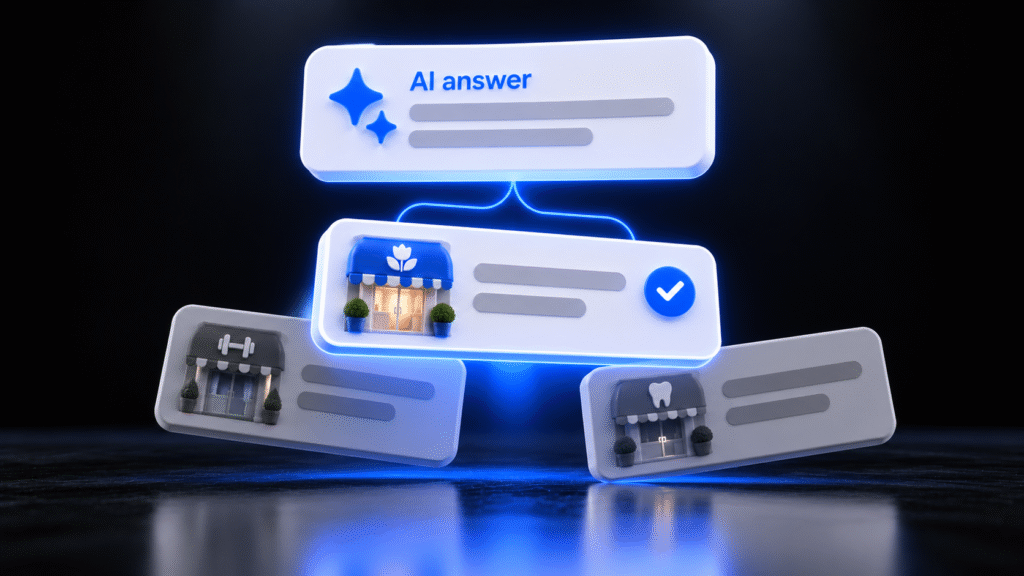
Nobody outside Google and OpenAI knows the exact recipe. But a fair amount is documented. Start there.
What Google says. In its Search Central guide on AI features, Google says AI Overviews and AI Mode may run several related searches across subtopics to build one answer. It calls this query fan-out. To be shown as a supporting link, a page has to be indexed and eligible to show in regular search with a snippet. Google says plainly there are no additional requirements and no special optimizations needed, no special schema and no new AI text files. And it specifically tells site owners to check that their Business Profile information is up to date.
Read that twice. The same profile and website that feed your map listing feed the AI answer.
What OpenAI says. ChatGPT search sends the question out through its search providers and partners, then builds an answer from what comes back, with sources attached. OpenAI says any website can choose to appear in ChatGPT search, which in practice means not blocking OpenAI’s search crawler (OAI-SearchBot) on your site or at your hosting company.
What the experts are seeing. Whitespark’s 2026 Local Search Ranking Factors survey, published November 6, 2025, asked local search experts to score factors for AI search visibility for the first time. Its summary: 3 of the top 5 AI search visibility factors are citation factors. In Whitespark’s words, “In AI SEO, mentions (citations) are the new link.” The survey’s advice includes getting listed on expert curated “best of” lists and on the prominent directory sites in your industry.
Our opinion, labeled as opinion. Put all of that together and the pattern looks like this. AI tools try to give a confident answer. They are confident when many sources agree. If your profile, your website, your reviews and three directories all say you are an emergency plumber in Mesa who works weekends, the AI can repeat that without risk. If your website, profile and directory listings disagree, the safe move for the AI is to name someone else.
What Still Matters From Classic Local SEO
Plenty of people sell AI search like it replaced local SEO. It did not. It sits on top of it.
Google’s own help page says local results are based mainly on relevance (how well your profile matches the search), distance (how far you are from the searcher) and how well known your business is, which includes your reviews and links to your business. It also says businesses with complete and accurate info are more likely to show up. None of that went away.
Here is what still pulls double duty for both the map pack and AI answers:
- Your Google Business Profile. Categories, services, hours, attributes, photos and description. We covered the full setup in our Google Business Profile optimization guide.
- Reviews. Volume, recency and what people actually write. BrightLocal found 74 percent of consumers only care about reviews from the last three months.
- Your website. One clear page per service, real location pages and content that matches your profile.
- Consistent listings. Same name, address and phone everywhere. More on that in our post on local business listing management.
- Accurate hours. Including holidays. An AI that sends someone to a closed business learns fast not to trust that listing.
Skipped the basics? AI search will not save you. Did them well? You are halfway there.
Local Pack vs AI Answers: What Is Different
Same customer, same need, two very different screens.
| Classic local pack | AI answers (AI Overviews, AI Mode, ChatGPT) | |
|---|---|---|
| What the customer sees | Three businesses on a map with stars and a call button | A written answer that may name a few businesses and explain why |
| Main data source | Your Google Business Profile | Your profile plus your website, reviews, directories and other mentions |
| What reviews do | Stars and count build trust at a glance | What reviews say gets summarized into reasons to pick you |
| How the customer refines | Scrolls, taps filters, compares | Asks a follow up question like “which one is open now” |
| Clicks to your website | Common | Less common, since the answer often ends the search |
| What wins | Strong profile, reviews, proximity | Strong basics plus consistent, specific, quotable facts in many places |
| How you track it | Rank trackers and profile insights | Mostly manual checks, since reporting is still limited |
Notice the last row. You cannot pull a clean report on AI answers yet. Google does count AI Overview and AI Mode traffic inside the Search Console Performance report, but it is mixed in with regular web results. So the honest check is to ask the tools yourself, once a month.
AI Search for Local Business: How to Make Yourself Easy to Quote
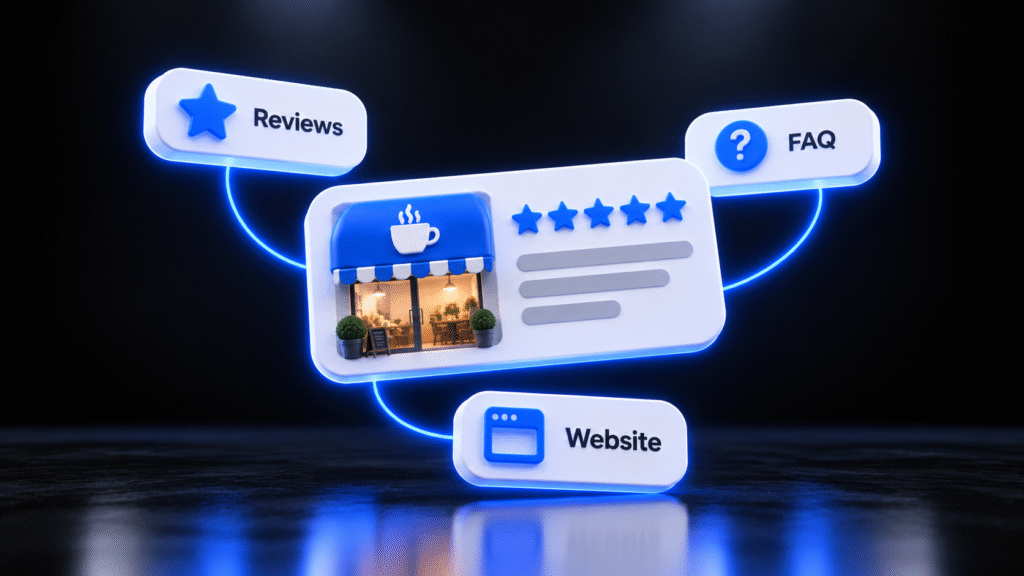
An AI answer is a summary of what the internet says about you. Give it something clear to say. Four moves do most of the work.
1. Complete your profiles, every field. Primary category exact. Every real secondary category. Every service listed by name, with a short description. Attributes filled in (wheelchair accessible, women owned, free estimates, whatever applies). Hours and holiday hours current. Start with Google, then Apple Business, Bing Places, Yelp and Facebook. BrightLocal’s 2026 survey found Apple Maps usage for reviews nearly doubled, from 14 percent to 27 percent, so do not skip Apple.
2. Get reviews that name the service. “Great job, thanks!” tells an AI nothing. “They replaced our water heater the same day and cleaned up after” tells it you do water heaters, same day, and you are tidy. When you ask for a review, ask about the specific job. Then reply to every review, and use the service name naturally in your reply. Our guide on how to respond to Google reviews has templates.
3. Build clear website pages and real FAQs. One page per service. One page per area you actually serve. Each page should answer, in plain text near the top: what you do, where, for whom, when you are available and how to book. Then add an FAQ section with the questions customers ask on the phone. “Do you take Delta Dental?” “Do you charge for estimates?” “How fast can you come out?” People type those almost word for word into ChatGPT. Keep important details in text, not inside images or PDFs. If your site cannot do this cleanly, a conversion focused website built around your services fixes it.
4. Make every listing say the same thing. Same business name, same address format, same phone number, same hours, same service list. Then go after the mentions Whitespark’s experts flagged: industry directories, local “best of” lists, your chamber of commerce, local news and association pages.
A quick technical check while you are at it. Ask whoever manages your site to confirm you are not blocking Googlebot or OpenAI’s search crawler in your robots.txt file or at your hosting or security provider. Some security settings block bots by default.
One more thing most owners miss. When AI sends someone to you, they call. If that call rings out, the AI did its job and you did not. That is the gap our post on the AI receptionist for small business covers.
An AI Search Checklist You Can Run This Week
Do these in order.
- Ask the AI about yourself. Open ChatGPT, Google AI Mode and a regular Google search. Type the questions a customer would, like “best [your service] in [your city]”. Note who gets named.
- Fill every field on your Google Business Profile. Categories, services with descriptions, attributes, hours, holiday hours, photos.
- Claim and match Apple, Bing, Yelp and Facebook. Same name, address, phone, hours and services as Google.
- Fix one website page. Start with your best selling service. Put what, where, who, when and how to book in plain text near the top.
- Add five real FAQs. Use the exact questions your front desk hears every week.
- Change your review request. Ask customers to mention the specific service they got.
- Reply to every unanswered review, naming the service where it fits naturally.
- Check your robots.txt and security settings so search crawlers are not blocked.
- Pick two local mentions to go after. An industry directory and a local list or association page.
- Repeat the AI check next month and compare.
The first three cost nothing but an afternoon, and they feed the map pack and AI answers at the same time.
Where BizWarrior Fits
BizWarrior is a young agency that helps local businesses get more clients with software and marketing that sell. For AI search, that mostly means doing the unglamorous work in this post so it actually gets finished: cleaning up your profiles and listings, setting up a review routine that asks for specifics, and building website pages and FAQs that say clearly what you do.
If AI is sending you calls you cannot pick up, our custom AI receptionist is built to answer them, day or night. You can see everything we do here.
Curious what ChatGPT says about your business right now? Talk to us. We will run the checks with you and tell you plainly what to fix first.
Frequently Asked Questions
How do I get my business recommended by ChatGPT?
There is no form to submit and no paid placement. ChatGPT search pulls answers from third-party search providers and partner data, so it leans on what the web already says about you. Do not block OpenAI’s search crawler, keep your profiles and listings complete and consistent, collect reviews that name your services, and earn mentions on respected local sites.
Do I need special code or schema to show up in Google AI Overviews?
No. Google’s Search Central guidance says there are no additional requirements or special optimizations to appear in AI Overviews or AI Mode, and no special schema is needed. Your pages need to be indexed and eligible to show in regular search with a snippet. Google also tells businesses to keep their Business Profile information up to date.
Is local SEO dead now that people use AI search?
No. AI answers sit on top of local SEO. Google says local results depend mainly on relevance, distance and how well known a business is, and its AI features draw on the same index and Business Profile data. The same basics help you in both places.
How many people actually use AI to find local businesses?
According to BrightLocal’s Local Consumer Review Survey, published in February 2026, 45 percent of US consumers used ChatGPT or other generative AI tools for local recommendations, up from 6 percent the year before. At Google I/O in May 2026, Google said AI Overviews had over 2.5 billion monthly users and AI Mode had passed 1 billion.
Do reviews affect what AI says about my business?
Very likely, yes. AI answers often explain why a business is a good pick, and reviews are one of the richest sources of that detail. A review that names the service and how it went gives AI tools specific facts to repeat. Ask customers to mention the service.
How can I tell if AI tools mention my business?
Ask them. Once a month, type the questions your customers would ask into ChatGPT, Google AI Mode and regular Google, and note who gets named and what is said. Google includes AI Overview and AI Mode traffic in the Search Console Performance report, but it is mixed with regular web results, so manual checks are still the clearest view.
What should a local business fix first for AI search?
Start with your Google Business Profile: every category, service, attribute and hour filled in correctly. Next, match that information on Apple, Bing, Yelp and Facebook. Then fix your most important service page so it states what you do, where, for whom and how to book in plain text.
Sources
- BrightLocal, Local Consumer Review Survey 2026 (February 11, 2026): https://www.brightlocal.com/research/local-consumer-review-survey/
- Google, Sundar Pichai’s Google I/O 2026 keynote remarks (May 19, 2026): https://blog.google/innovation-and-ai/sundar-pichai-io-2026/
- Pew Research Center, Google users are less likely to click on links when an AI summary appears in the results (July 22, 2025): https://www.pewresearch.org/short-reads/2025/07/22/google-users-are-less-likely-to-click-on-links-when-an-ai-summary-appears-in-the-results/
- Google Search Central, AI features and your website (last updated December 10, 2025): https://developers.google.com/search/docs/appearance/ai-features
- OpenAI, Introducing ChatGPT search (October 31, 2024): https://openai.com/index/introducing-chatgpt-search/
- Whitespark, Local Search Ranking Factors (2026 edition, published November 6, 2025): https://whitespark.ca/local-search-ranking-factors/
- Google Business Profile Help, Tips to improve your local ranking on Google: https://support.google.com/business/answer/7091